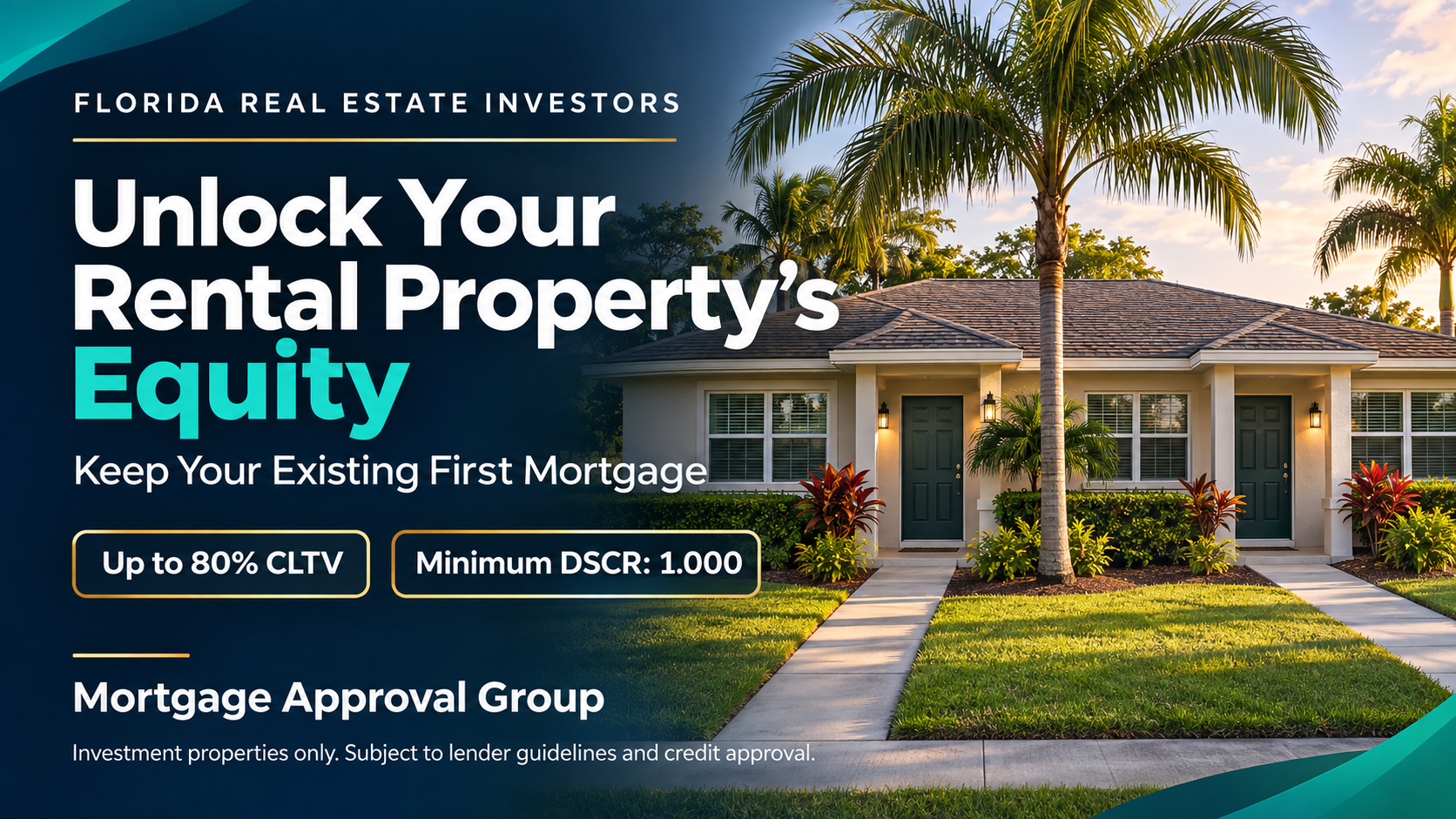
Florida real estate investors who built equity in a rental property often face a familiar problem: accessing that equity typically means refinancing the first mortgage. If your existing rate is favorable, that trade-off may not make sense.
A DSCR second mortgage is one option that may allow eligible investors to access rental-property equity while leaving the existing first mortgage in place. This article explains how the program works, what the qualification requirements are, and what investors should understand before pursuing it.
What Is a DSCR Second Mortgage?
A DSCR second mortgage is a second-lien loan secured by an investment property. Like a standard DSCR loan, it may qualify primarily using the property's rental income rather than the borrower's personal income or tax returns.
The key distinction from a traditional cash-out refinance: the existing first mortgage stays in place. The second mortgage is a separate loan added behind it.
This structure may be worth exploring when:
- Your existing first mortgage carries a rate you prefer to keep
- You want to access equity without resetting your loan term
- The property generates rental income that supports the additional debt
How the DSCR Qualification Works
DSCR stands for Debt Service Coverage Ratio. It compares the property's eligible rental income against its measured monthly debt obligation.
For a DSCR second mortgage, the ratio calculation typically accounts for the combined obligations of both the existing first mortgage and the proposed second mortgage — not just the second mortgage alone.
A minimum DSCR of 1.000 is required. This means the property's eligible rental income must at least equal the measured combined monthly obligation.
The precise calculation varies by lender. Items considered in the monthly obligation typically include:
- Principal and interest on both loans
- Property taxes
- Homeowners insurance
- HOA dues where applicable
Because the second mortgage adds to the total monthly obligation, the property's rental income must be sufficient to cover both loans at or above the 1.000 threshold.
Combined Loan-to-Value (CLTV) Limit
The maximum combined loan-to-value for this program is 80% CLTV.
CLTV measures the total of all loans secured by the property — the existing first mortgage balance plus the proposed second mortgage — as a percentage of the property's current appraised value.
Hypothetical Equity Example
The following is a hypothetical illustration only. Actual results depend on your property's appraised value, existing mortgage balance, rental income, and lender underwriting.
| Property value | $500,000 |
| Maximum combined financing at 80% CLTV | $400,000 |
| Existing first mortgage balance | $250,000 |
| Potential second mortgage before costs | $150,000 |
In this example, the investor could potentially access up to $150,000 through a second mortgage while keeping the existing first mortgage in place — subject to DSCR qualification, lender approval, and all applicable underwriting requirements.
Want to see what your rental property may qualify for? Schedule a review of your property value, mortgage balance, and rental income with our team.
What This Program Is Not
It is important to understand what a DSCR second mortgage is not:
- It is not a HELOC. This is a closed-end second mortgage, not a revolving line of credit.
- It is not available on primary residences. This program applies to investment properties only.
- Rental income qualification does not eliminate other underwriting requirements. Credit, property condition, equity, and other factors are still evaluated by the lender.
Do not assume that every feature described for a standard DSCR purchase or refinance loan applies here. Program guidelines vary by lender, and availability is subject to change.
Who This May Be Worth Exploring
A DSCR second mortgage may be worth discussing with a loan officer if:
- You own a Florida investment property with meaningful equity
- Your existing first mortgage has a rate or term you prefer to keep
- The property generates rental income that may support a 1.000 DSCR on the combined debt
- You want to access capital for another investment, renovation, or other purpose
It may not be the right fit if:
- The property's rental income does not support a 1.000 DSCR after adding the second mortgage payment
- The combined loan balances would exceed 80% of the property's current value
- The property is a primary residence or second home
Documentation Typically Required
Documentation requirements vary by lender. Items commonly requested for a DSCR second mortgage include:
- Lease agreement or market rent documentation (Form 1007)
- Property appraisal
- Mortgage statement for the existing first mortgage
- Property tax and insurance documentation
- Entity documentation if the property is held in an LLC or other business entity
Personal tax returns and employment verification are typically not required for DSCR qualification, though lenders may request additional documentation based on the specific transaction.
Internal Links and Related Resources
For background on how DSCR loans work generally, see our educational article: DSCR Loans Explained: How Florida Real Estate Investors Can Qualify Using Rental Income.
For the DSCR loan product page, including purchase and refinance options: DSCR Investor Loans.
For investors considering a second mortgage on a primary residence or non-investment property, see Home Equity Loans — note that program guidelines differ from the investment-property DSCR second mortgage described here.
Frequently Asked Questions
Does a DSCR second mortgage require personal income documentation?
Many DSCR programs do not require personal tax returns or employment verification. Qualification is based primarily on the property's rental income relative to its combined debt obligation. However, documentation requirements vary by lender, and other underwriting factors still apply.
Can I use an LLC to take out a DSCR second mortgage?
Some lenders allow DSCR second mortgages on properties held in an LLC or other business entity. Requirements vary, and not all lenders offer this option. Discuss your entity structure with your loan officer before applying.
Does the 80% CLTV include my existing first mortgage?
Yes. The 80% CLTV limit applies to the combined total of your existing first mortgage balance and the proposed second mortgage, measured against the property's current appraised value.
Is a DSCR second mortgage available on short-term rentals?
Availability for short-term rental properties varies by lender. Some lenders accept short-term rental income using documented platforms such as Airbnb or VRBO, while others require long-term lease documentation. Confirm with your loan officer which rental income documentation is acceptable for your property.
What happens if my DSCR falls below 1.000 after adding the second mortgage?
A DSCR below 1.000 typically means the property does not meet the minimum qualification threshold for this program. In that case, the second mortgage may not be available at the requested amount, or the program may not be a fit for the property. Your loan officer can review the numbers with you.
Investment properties only. Subject to lender guidelines, credit approval, and property eligibility. Program availability and terms vary by lender and are subject to change. The hypothetical example above is for illustrative purposes only and does not represent a loan offer or guarantee of qualification. Contact Mortgage Approval Group to discuss your specific situation.
Scott Kepler, NMLS #833792 | Mortgage Approval Group, NMLS #1742769 | (813) 255-2557 | Apply Online


